
I haven’t published in the last two weeks. My silence was deliberate. I’ve been underground finalizing Nativist Nation, the book I coauthored with Kirby Goidel, on identity, nativism, and political realignment in the U.S. and beyond. With the revised manuscript now in, I’m back. Book will be out in September. And the timing couldn’t be better.
Earlier this week, I joined Bloomberg to talk about the early days of Trump’s second term. The interview drew from a fresh Ipsos analysis—Trump and the Next 100 Days: Knowing the New America1. The findings offer a nuanced view of a country that is cautious, conditionally optimistic, and still attuned to process and priorities.
Here are five signals that stood out—and what they might mean for what comes next.
1. Americans are pessimistic about the present—but cautiously hopeful about the future.
Only one in five Americans believe the economy has improved since Trump took office in January. But when asked about the year ahead, over a third expect things to get better—and among Republicans, that number climbs to 63%. This optimism isn’t euphoric, but it’s real. The mood is less “we’re doing great” and more “things might finally turn around.” In a polarized and economically fragile environment, even cautious optimism is a signal worth watching.
2. Trump’s approval is rising—but his focus may not match public priorities.
Trump’s approval ratings have ticked upward—an unusual pattern for this early stage in a second term, when most presidents face early erosion. But underneath that improvement is a disconnect. Americans are clear about what matters most to them: lowering the cost of living and protecting programs like Social Security and Medicare. Yet Trump is more associated with tax cuts, immigration enforcement, and DEI policy rollbacks. That’s not where voters are. If Trump wants to solidify gains, he’ll need to move toward the center of public concern.
3. The public is split on tariffs—wary in the short term, but hopeful over the long haul.
When asked about the economic effects of tariffs over the next year, only 23% of Americans expect a positive impact. But when the frame shifts to the long term, a different picture emerges: majorities believe tariffs will help bring back manufacturing and create U.S. jobs. This is the logic of conditional support—Americans are open to short-term sacrifice, but only if there’s a believable, collective payoff. Trump has an opening here, but it hinges on narrative discipline and demonstrable outcomes.
4. Republicans still dominate key issue terrain—especially on immigration and the economy.
Despite public dissatisfaction with some of Trump’s early choices, Republicans continue to lead on the big structural issues. The GOP holds a clear edge on immigration, economic management, and foreign affairs. These are not just base positions—they resonate with a wider segment of independents as well. In a noisy political environment, issue ownership remains a durable form of strategic capital. Trump’s challenge isn’t credibility—it’s alignment with emerging voter priorities.
5. Americans still expect leaders to follow the rules of the game.
Perhaps the most striking finding is just how much Americans—across partisan lines—still care about norms and process. A majority believe Trump should comply with court rulings. Even among Republicans, a third agree. And when asked about governance style, nearly eight in ten say they prefer a president who works with Congress rather than governs by executive order. These are not marginal preferences. They speak to a public that still values constitutional guardrails and institutional balance—even in an age of disruption. They want less not more friction.
What the Narrative Actually Gets Wrong and What’s Actually Going On
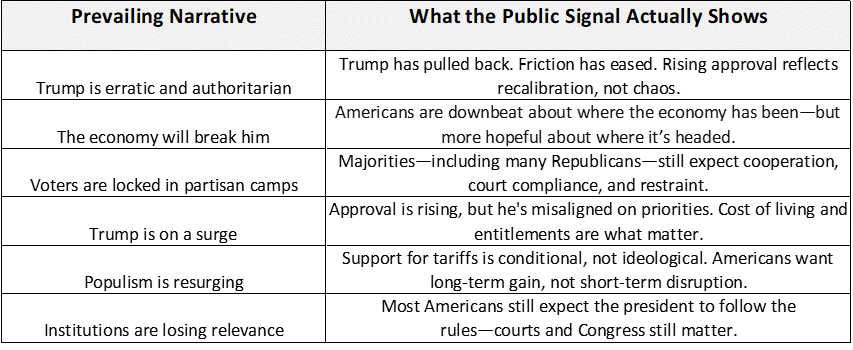
Final Thought: Trump is in a stronger position than many think—but constraint still defines the moment.
Over the past month, Trump has stepped back from some of the edge—the rhetoric has cooled, the friction has eased, and the public mood has shifted. Pessimism now feels more backward-looking than forward-facing. The temperature has dropped, but the pressure remains. Trump finds himself in a surprisingly strong position: rising approval, resilient Republican issue strength, and—for now—economic forecasts that suggest stability rather than collapse.
But that doesn’t mean the road is clear. The next 100 days will test whether Trump can converge with public priorities—especially around cost of living and entitlement protections—without reigniting unnecessary friction. The projected economic slowdown is unlikely to be politically catastrophic, but it could shave approval ratings at the margins and subtly recalibrate the mood.
The path is narrower than it looks, but it is open.
